
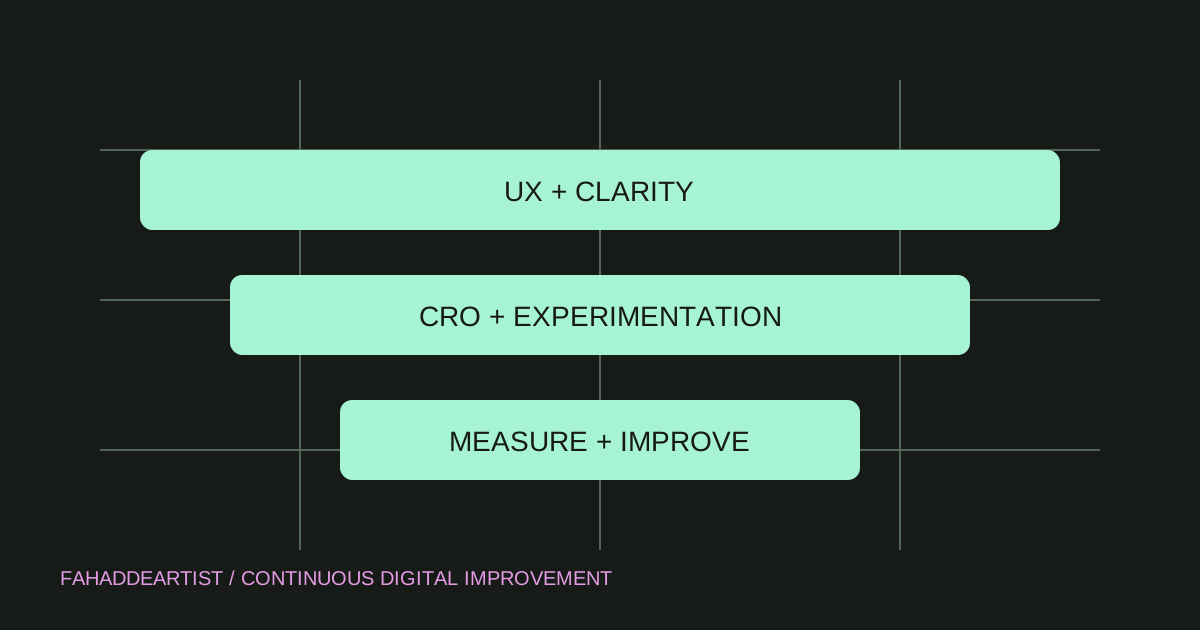
Define the business goal before the metric
A conversion is the action that matters to your business. For a consultancy, a suitable enquiry may matter more than a click. First define who should enquire, what problem you solve and how your team recognizes a qualified lead. Separate the primary outcome from supporting actions such as CTA clicks or form starts. A higher click count alone does not establish commercial progress.
Review the customer journey as one connected path
Follow the path of a new visitor: search result or ad, landing page, service description, evidence, CTA, form and confirmation. At each transition, record the question the visitor needs answered. On mobile, check readability, reachable controls and understandable errors. A clear confirmation should explain what happens after an enquiry. Routing the request to the right person internally is also part of the journey.
Understand behaviour before choosing solutions
A funnel shows where people leave, but does not automatically explain why. Combine available analytics with usability observations, customer questions and sales feedback. Check that events have meaningful definitions and are recorded consistently. Where the data supports it, compare device types and acquisition sources. A mobile form problem can disappear inside an overall average.
Write hypotheses and set priorities
Describe each idea as a testable assumption: removing a specific barrier should change a defined outcome for a particular audience. Record the supporting observation, effort and potential side effects. Clear functional errors can be fixed directly. Uncertain design decisions need stronger evidence. Start with the most important supported obstacle instead of changing the entire page at once.
Document results so they remain useful
Record the baseline, change, time period, data source and limitations. Consider form completion and lead quality together: fewer questions might produce more enquiries while making qualification harder. Review whether the change helps the team in practice. An unsupported hypothesis is also useful learning. Feed it back into the next analysis so the same idea is not repeated later without context.